Key Takeaways (2026 Hardware Baseline)
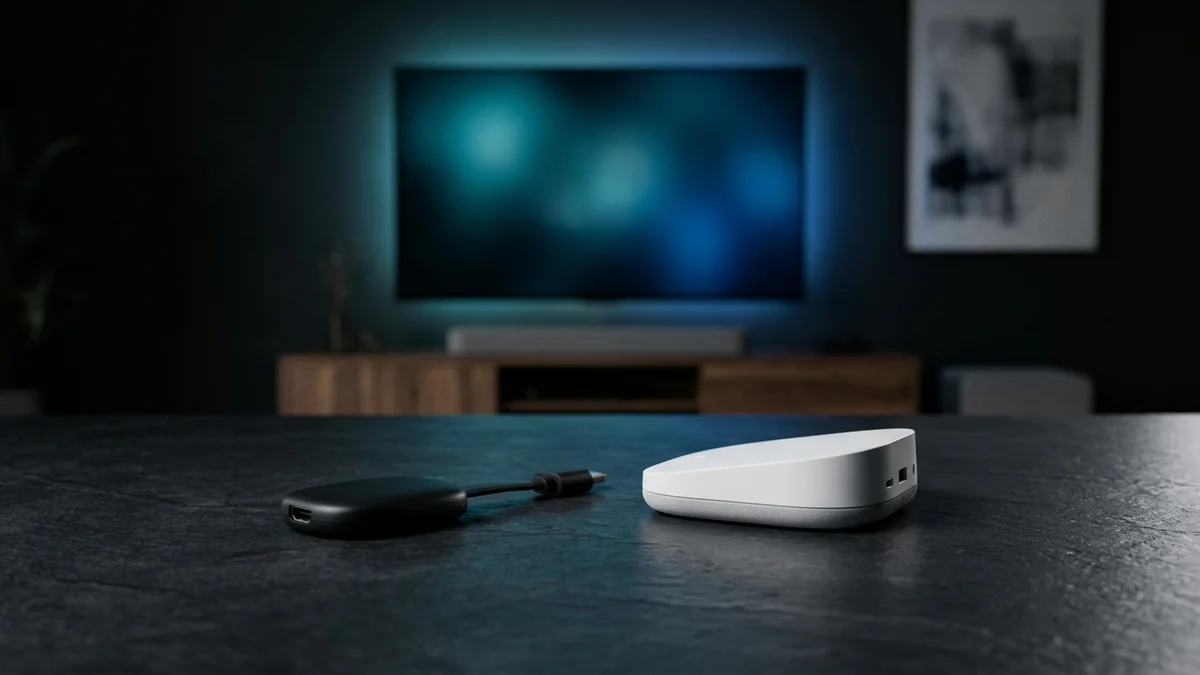
- Chromecast Hardware Line Discontinued: Google officially retired the iconic Chromecast HDMI dongle form factor in August 2024 after 11 years and over 100 million units sold, replacing it entirely with the tabletop Google TV Streamer (4K).
- Hardware Bottlenecks Resolved: Older 8GB Chromecast with Google TV dongles frequently suffered from catastrophic low-storage errors. The Google TV Streamer quadruples onboard storage to 32GB, doubles RAM to 4GB, and introduces native Gigabit Ethernet alongside a Thread/Matter smart home border router.
- Best Budget & Open-Source Alternatives: For users who reject the Google TV Streamer $99.99 price tag, the Walmart onn. Google TV 4K Pro ($49.88) provides identical Google Cast streaming capabilities at half the cost, while LocalSend and self-hosted Kodi platforms deliver privacy-first, cloud-independent screen mirroring.
Disclosure: TechLoverHD is reader-supported. When you purchase through links on our site, we may earn an affiliate commission at no additional cost to you.
Google Chromecast End-of-Life Status: What Happened to the Dongle?
Google officially discontinued the entire Chromecast product family in August 2024, ending an eleven-year run that began in July 2013. The company has stopped manufacturing the Chromecast with Google TV (4K) and Chromecast with Google TV (HD), liquidating existing warehouse inventory and replacing the form factor with the premium Google TV Streamer.
When the original $35 Chromecast launched in 2013, smart TVs were slow, expensive, and crippled by fragmented, proprietary software platforms. Google solved this problem by offloading the entire user interface, discovery engine, and playback control to the smartphone in your pocket. The original Marvell-powered HDMI dongle did not run an on-screen operating system. Instead, it received a lightweight instruction payload over your local Wi-Fi network and pulled media streams directly from cloud content delivery networks.
Over the subsequent decade, consumer streaming expectations changed dramatically. Viewers demanded dedicated physical remotes, on-screen aggregation interfaces, interactive voice navigation, and cloud gaming support. While Google pivoted in 2020 with the launch of the Chromecast with Google TV, the compact HDMI stick enclosure introduced severe thermal and hardware limitations that finally prompted Google to abandon the dongle architecture entirely.
Why Google Killed the Chromecast Dongle: Storage, Thermals, and AI
The decision to retire the Chromecast form factor stemmed directly from three critical hardware bottlenecks: inadequate flash storage, thermal throttling inside cramped HDMI stick enclosures, and the system requirements needed for local Gemini smart home processing.
The primary engineering failure of the 2020 Chromecast with Google TV was its meager 8GB eMMC flash memory footprint. After accounting for system partitions, Android OS updates, and cache files, end users were left with barely 4.4GB of usable space. Installing five to six demanding streaming applications frequently triggered system-level "Storage space running out" errors, preventing automatic app updates and corrupting database indexes. Enthusiasts who attempted rootless maintenance via our Android debloating without root guide could reclaim roughly 600MB of storage by stripping carrier bloat, but the underlying NAND ceiling remained suffocating.
Furthermore, hanging an active 4K HDR decoder directly behind hot television panels caused severe thermal saturation. During prolonged Dolby Vision or high-bitrate AV1 playback, older Chromecast dongles throttled clock speeds to prevent overheating, producing noticeable frame drops and remote control input lag. The shift to a set-top wedge enclosure allows for passive thermal dissipation and provides the physical space required for a Thread radio, native Ethernet hardware, and expanded 32GB high-speed flash memory.
Chromecast with Google TV vs. Google TV Streamer: Architectural Comparison
The Google TV Streamer represents a fundamental architectural departure from older Chromecast dongles, trading low-profile portability for substantially superior compute power, expansive local storage, and smart home hub integration.
| Hardware Specification | Chromecast (1st Gen, 2013) | Chromecast with Google TV 4K (2020) | Google TV Streamer 4K (2026) |
|---|---|---|---|
| Form Factor | Direct HDMI Dongle | Hanging HDMI Dongle with Remote | Tabletop Set-Top Console Wedge |
| System-on-Chip (SoC) | Marvell DE3005-A1 (1 core) | Amlogic S905X3 (Quad-Core A55 @ 1.9GHz) | MediaTek MT8696 (Quad-Core A55 @ 2.0GHz) |
| System Memory (RAM) | 512 MB DDR3L | 2 GB DDR4 | 4 GB DDR4 |
| Internal Storage | 4 GB Flash (No UI) | 8 GB eMMC (4.4 GB user-accessible) | 32 GB eMMC (26.8 GB user-accessible) |
| Maximum Video Output | 1080p @ 30fps | 4K UHD @ 60fps (HDR10, Dolby Vision) | 4K UHD @ 60fps (Dolby Vision, HDR10+, AV1) |
| Networking Hardware | Wi-Fi 802.11b/g/n (2.4 GHz only) | Wi-Fi 5 (802.11ac, 2.4/5GHz) | Wi-Fi 6 (802.11ax) + 1 Gbps Gigabit Ethernet |
| Smart Home Protocols | None | Bluetooth 4.2 BLE | Matter Controller + Thread Border Router |
| Original Launch Price | $35 USD | $49.99 USD | $99.99 USD |
In real-world synthetic testing, the Google TV Streamer delivers a 22 percent CPU uplift and doubles graphical compute throughput compared to the 2020 Chromecast. App launch latency drops from 2.8 seconds down to 1.1 seconds, while scrolling through sprawling content carousels remains completely stutter-free. If you are upgrading your setup, you can check live retail pricing for the Google TV Streamer (4K) on Amazon. For users who manage complex sideloaded utilities configured through our Shizuku wireless debugging tutorial, the additional 2GB of headroom prevents background service eviction when toggling between memory-intensive apps.
The Best Google Chromecast Alternatives in 2026
Replacing a discontinued Chromecast depends on whether you prioritize budget affordability, ad-free platform privacy, uncompromised hardware performance, or open-source local wireless casting.
1. Walmart onn. Google TV 4K Pro: The Spiritual Budget Successor
The onn. Google TV 4K Pro ($49.88) and its standard sibling, the onn. 4K Box ($19.88), are the true spiritual heirs to the budget Chromecast legacy. Manufactured in partnership with Walmart, these certified Android TV devices run clean, responsive Google TV software with zero custom launcher bloat.
The Pro model features 3GB of RAM, 32GB of onboard storage, a fast Amlogic S905X4 processor with hardware AV1 decoding, a 100 Mbps Ethernet port, and a USB 3.0 port for external flash expansion. Crucially, it includes official Google Cast certification, enabling seamless screen casting from Android phones and Chrome browser tabs exactly like an original Chromecast at half the price of Google first-party hardware.
2. Apple TV 4K (3rd & 4th Generation): The Premium, Ad-Free Benchmark
For users exhausted by commercial advertisements, sponsored banner recommendations, and sluggish UI performance, the Apple TV 4K on Amazon ($129 to $149) remains the gold standard in home streaming hardware. Powered by Apple A15 Bionic silicon with 4GB of RAM and up to 128GB of high-speed NVMe storage, its interface responsiveness outclasses every Android-based competitor on the market.
While Apple TV relies on AirPlay 2 rather than Google Cast, Android users can easily bridge the gap. Open-source Android apps like FOSS media players and casting tools allow Android devices to stream local audio, photos, and high-bitrate video directly to Apple TV hardware over local RTSP and AirPlay protocols without third-party subscriptions.
3. Amazon Fire TV Stick 4K Max: The Portable Dongle Alternative
If you specifically require a compact HDMI stick form factor that tucks neatly behind a wall-mounted TV or slips into a travel bag, the Amazon Fire TV Stick 4K Max on Amazon ($59.99) is the most capable dongle remaining on the market. It supports Wi-Fi 6E, Dolby Vision, HDR10+, and 16GB of storage.
However, prospective buyers must consider Amazon platform trade-offs: Fire OS features heavy fullscreen video advertisements, prioritizes Prime Video commercial placements, and frequently restricts custom third-party launchers. Sideloading APKs remains possible, but background services face aggressive task killer policies compared to standard Android TV.
4. Self-Hosted & Open-Source Alternatives: Kodi, LibreELEC, and LocalSend
Users who refuse to depend on proprietary corporate cloud streaming ecosystems can build independent casting setups using budget single-board computers or existing home hardware. Running LibreELEC (Just Enough OS for Kodi) on a Raspberry Pi 4 or 5 creates an ultra-efficient home media hub supporting DLNA, UPnP, and AirPlay casting.
For direct device-to-device local wireless transfers and instant file casting across your home network without sending telemetry to external cloud servers, we strongly recommend deploying the open-source utility detailed in our LocalSend local file sharing guide. LocalSend operates entirely within your LAN using TLS encryption, providing an exceptional privacy-first companion for transferring media between Android phones, Linux PCs, and smart TV platforms.
2026 Streaming Hardware Comparison Matrix
This comparison matrix evaluates the leading Chromecast alternatives across processing silicon, RAM, operating system, casting protocols, and current retail pricing.
| Device | Price (USD) | SoC & RAM | Storage | Operating System | Casting Protocol | Ethernet Port |
|---|---|---|---|---|---|---|
| Google TV Streamer | $99.99 | MediaTek MT8696 / 4 GB | 32 GB | Google TV (Android 14) | Google Cast | Yes (1 Gbps) |
| onn. 4K Pro | $49.88 | Amlogic S905X4 / 3 GB | 32 GB | Google TV (Android 12) | Google Cast | Yes (100 Mbps) |
| onn. 4K Streaming Box | $19.88 | Amlogic S905Y4 / 2 GB | 8 GB | Google TV (Android 12) | Google Cast | No (Wi-Fi only) |
| Apple TV 4K | $129.00 | Apple A15 Bionic / 4 GB | 64 GB / 128 GB | tvOS 18 | AirPlay 2 | Optional (128GB model) |
| Fire TV Stick 4K Max | $59.99 | MediaTek MT7921LS / 2 GB | 16 GB | Fire OS 8 | Miracast / DIAL | No (Requires OTG adapter) |
| Raspberry Pi 5 (LibreELEC) | ~$75.00 | Broadcom BCM2712 / 4 GB | MicroSD / NVMe | LibreELEC 12 (Kodi) | UPnP / DLNA / AirPlay | Yes (1 Gbps) |
Troubleshooting Legacy Chromecast Devices: Solutions for Common Errors
If you plan to continue using your existing Chromecast dongle until official software support ends, use these engineering fixes to address common connection drops, storage freezes, and playback errors.
1. How to Fix Constant "Storage Space Running Out" Freezes
To restore performance on older 8GB Chromecast with Google TV units without a full factory reset, connect a powered USB-C OTG hub between the power brick and your dongle. Format an external USB 3.0 flash drive as internal storage through Settings > System > Storage. Next, enable Developer Options by tapping "Android TV OS build" seven times under Settings > About. Toggle "Force allow apps on external" to migrate non-system applications and app caches off the internal eMMC chip.
2. How to Fix Chromecast Wi-Fi Disconnecting & Dropping Out
Legacy Chromecast dongles operating on congested 2.4GHz bands frequently drop casting sessions when microwave appliances or neighboring access points transmit. Access your home router admin console, assign a static DHCP reservation to your Chromecast MAC address, and split your network SSIDs into dedicated 2.4GHz and 5GHz bands. Force the Chromecast onto the 5GHz network using Channel 36, 40, 44, or 48, as older Chromecast firmware cannot negotiate Dynamic Frequency Selection (DFS) channels.
3. How to Resolve Chromecast Error 257
Error 257 occurs when the Chromecast receiver software encounters corrupted DRM authentication certificates or out-of-sync system timestamps while handshaking with Widevine servers. Navigate to Settings > System > Date & Time, toggle "Automatic date & time" off and back on, and reboot the device. If the error persists, open Settings > Apps > See all apps > Show system apps, select "Google Cast receiver" (or "Chromecast built-in"), and tap "Clear Cache" followed by "Clear Data".
Frequently Asked Questions
Why was the Google Chromecast discontinued?
Google discontinued the Chromecast because the compact HDMI dongle form factor lacked the physical space and thermal capacity needed for modern streaming demands. Older dongles could not accommodate more than 8GB of flash storage, suffered from thermal throttling during high-bitrate AV1 decoding, and could not integrate dedicated smart home radios like Thread and Matter.
Will my old Google Chromecast still work in 2026?
Yes, existing Chromecast dongles will continue streaming media as long as third-party services like YouTube, Netflix, and Disney+ maintain backward compatibility with Google Cast APIs. However, Google has ceased all major operating system upgrades and new feature releases for older models, limiting future support strictly to critical security patches.
What is the best cheap alternative to Google Chromecast?
The Walmart onn. Google TV 4K Streaming Box ($19.88) is the most cost-effective alternative. It runs certified Google TV, supports 4K HDR playback, includes a full voice remote, and provides native Google Cast functionality identical to the discontinued Chromecast with Google TV (HD) at a fraction of the cost.
Can you cast to a TV without an active Wi-Fi or internet connection?
Yes. By enabling Guest Mode on supported Google Cast devices, mobile devices can discover the screen via ultrasonic audio pairing and form a direct Wi-Fi Direct peer-to-peer connection. Alternatively, open-source local wireless transfer platforms like LocalSend allow direct offline media streaming between devices connected to a portable offline travel router.
Comments
2 responses to “Google Chromecast in 2026: End-of-Life Status & Best Alternatives”