
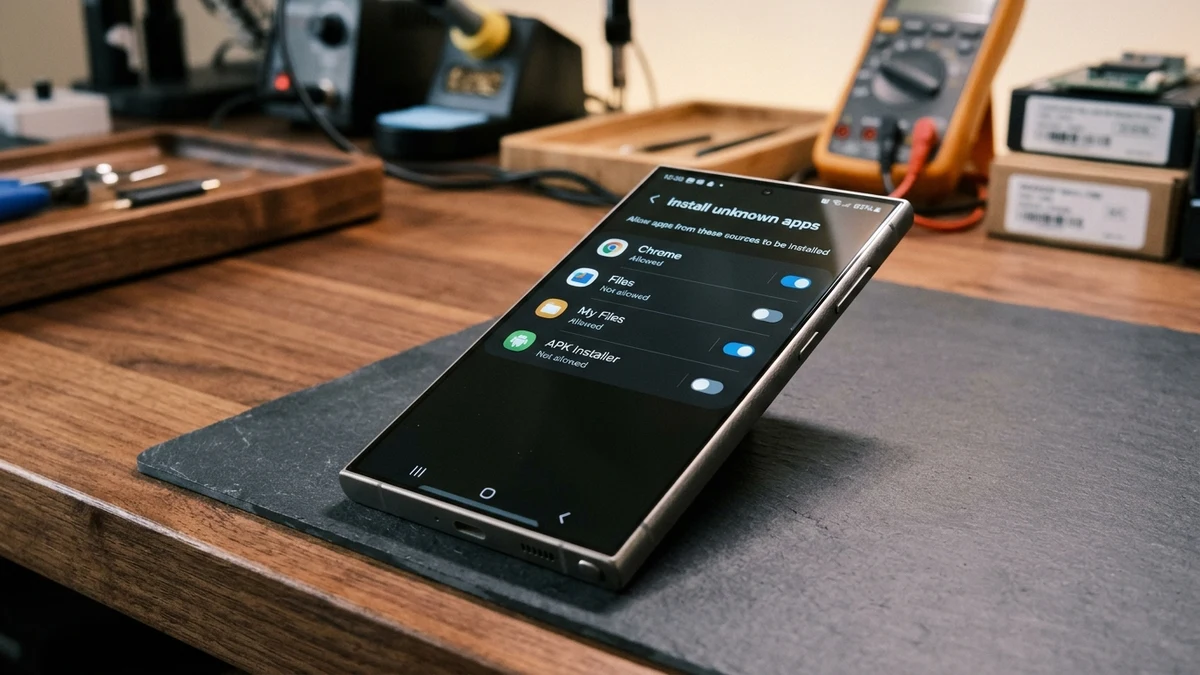
Sideloading allows you to install .apk files directly from independent developers without relying on the Google Play Store. It has been a defining advantage of the Android operating system since version 1.0. Whether you want to install open-source utilities from GitHub, load custom Google Camera ports, or run console emulators, sideloading puts full software ownership in your hands.
However, external APK installations work very differently today. The days of a single global “Unknown Sources” checkbox are long gone. Between Android 8.0 and Android 17, Google and hardware manufacturers added multiple layers of security. These include granular per-app installation permissions, Samsung Auto Blocker, Android Restricted Settings for Accessibility services, and real-time Google Play Protect scanning. In this updated 2026 guide, we walk through enabling unknown sources across every major Android skin. We also cover how to unlock greyed-out security toggles and fix common APK installation errors.
Why “Unknown Sources” Moved: Global Toggle vs. Per-App Permission
If you are searching for the classic Settings → Security → Unknown Sources toggle from Android 7.0 (Nougat) and earlier, it no longer exists on modern devices.
Under the legacy Android model, enabling Unknown Sources granted permanent, system-wide permission. Any app on your phone could trigger an APK installation. Malvertising browser popups frequently exploited this loophole. Starting with Android 8.0 (Oreo) and continuing through Android 15, 16, and 17, Google replaced that global switch with a scoped runtime permission called Install unknown apps (android.permission.REQUEST_INSTALL_PACKAGES).
Today, you must authorize the specific host application that downloads or launches the APK file. Common examples include your web browser (Chrome, Firefox, Cromite), your file manager (Files by Google, Samsung My Files), or an automated open-source updater like Obtainium APK.
Quick Reference: Where to Find “Install Unknown Apps” by Phone Brand
Because every manufacturer rearranges the Android Settings menu, use this cross-brand matrix to jump straight to the toggle on your specific device:
| Device Brand & OS Skin | Exact Menu Navigation Path (2026) | Extra OEM Hurdle to Check |
|---|---|---|
| Google Pixel (Stock Android 14 to 17) | Settings → Apps → Special app access → Install unknown apps | Restricted Settings (for Accessibility) |
| Samsung Galaxy (One UI 6 / 7 / 8 / 9) | Settings → Apps → ⋮ (3-dot menu) → Special access → Install unknown apps (or Settings → Security and privacy → More security settings → Install unknown apps) | Auto Blocker (Must be turned OFF first) |
| Xiaomi / Redmi / POCO (HyperOS & MIUI) | Settings → Privacy protection → Special permissions → Install unknown apps | 10-second MIUI/HyperOS security countdown prompt |
| OnePlus / OPPO / Realme (OxygenOS / ColorOS) | Settings → Apps → Special app access → Install unknown apps | Payment protection scan on financial apps |
| Motorola / Nothing / ASUS (Near-Stock AOSP) | Settings → Apps → Special app access → Install unknown apps | Standard Play Protect verification |
| Legacy Android (Android 4.0 to 7.1) | Settings → Security (or Lock screen and security) → Unknown Sources | Global system-wide checkbox |
Step 1: How to Enable “Install Unknown Apps” on Modern Android (Android 8 to 17)
Follow these steps to authorize your browser, file manager, or package manager to install APK files:
- Open your phone’s Settings app and navigate to Apps.
- Scroll to the bottom and tap Special app access (on Samsung One UI, tap the three-dot menu (⋮) in the top-right corner of the Apps screen and select Special access).
- Tap Install unknown apps.
- Select the application you will use to open the
.apkfile (for example, Chrome, Files by Google, My Files, or Obtainium). - Toggle Allow from this source (or Allow permission) to ON.
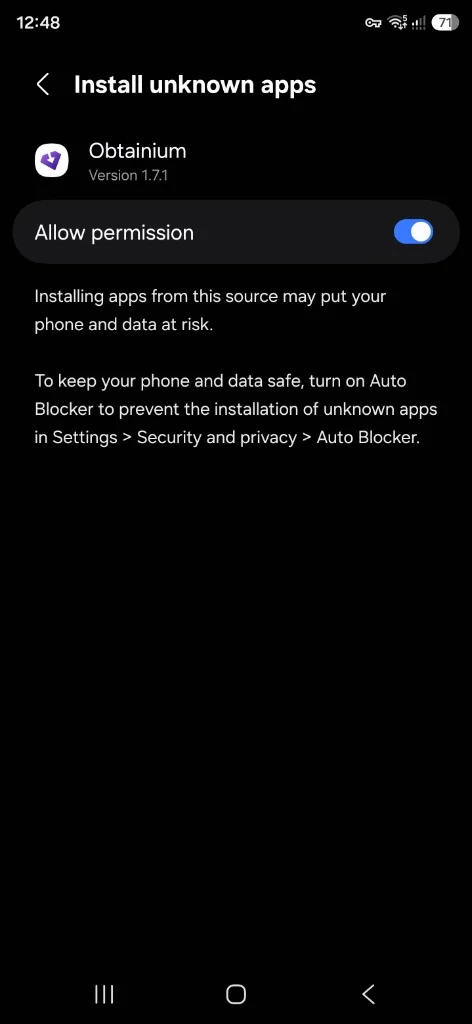
Security Best Practice: If you grant your web browser permission to install unknown apps for a one-off download, toggle Allow from this source back to OFF once you finish. For ongoing sideloading, use a dedicated open-source updater like Obtainium. It tracks releases and verifies developer signing certificates automatically.
Step 2: Why Is “Install Unknown Apps” Greyed Out on Samsung? (Auto Blocker Fix)
On modern Samsung Galaxy smartphones running One UI 6.1.1, One UI 7, One UI 8, and One UI 9 (Android 17), Samsung enables a system-level security feature called Auto Blocker out of the box.
When Auto Blocker is active, Samsung completely blocks APK sideloading from unauthorized sources. It greys out the Install unknown apps toggle across all browsers and file managers. It also blocks ADB commands over USB cables.
To disable Samsung Auto Blocker so you can sideload APKs:
- Open Settings on your Samsung Galaxy phone or tablet.
- Navigate to Security and privacy.
- Scroll down and tap Auto Blocker.
- Toggle Auto Blocker to OFF and authenticate with your fingerprint, PIN, or pattern.
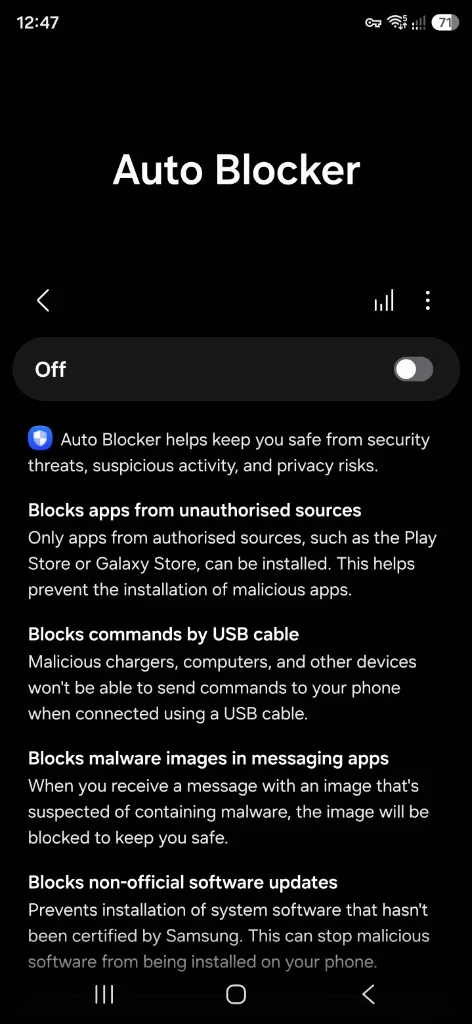
Once Auto Blocker is turned off, return to Settings → Apps → ⋮ → Special access → Install unknown apps, and the toggles will be unlocked.
Step 3: How to Bypass “Restricted Settings” on Android 13, 14, 15, 16 & 17
Starting in Android 13 and expanded aggressively in Android 15 through Android 17, Google introduced Enhanced Confirmation Mode (Restricted Settings).
If you download an APK directly from a web browser or file manager and that app requests Accessibility Service permissions or Notification Listener access, Android blocks the toggle. You will see a popup dialog stating: “Restricted setting: For your security, this setting is currently unavailable.”
Method A: Unlock Restricted Settings Manually (No Root Required)
You can lift this restriction for any trusted sideloaded APK in 15 seconds:
- Attempt to enable the Accessibility or Notification permission inside the app until the “Restricted setting” popup appears. Tap OK. This action triggers the unlock option in your system settings.
- Open Settings → Apps and select the sideloaded application from your app list.
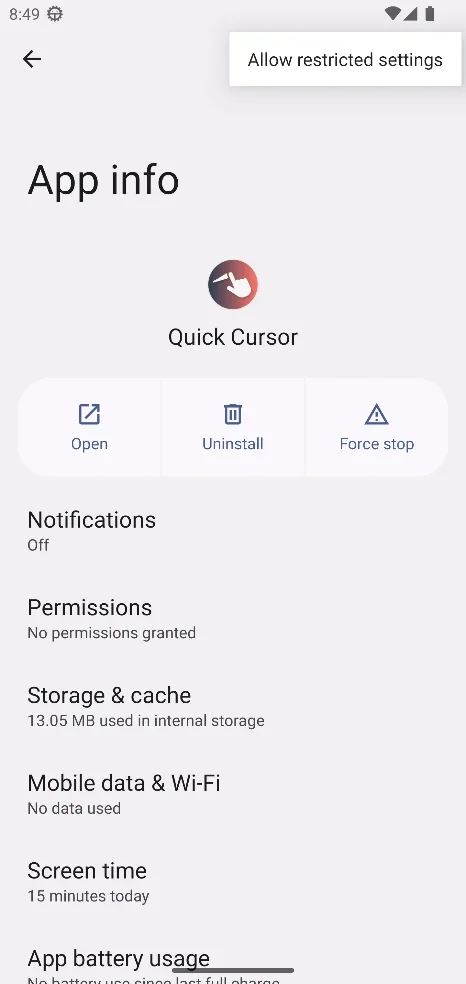
- Tap the three-dot menu (⋮) in the top-right corner of the App Info screen.
- Tap Allow restricted settings.
- Verify your identity using your fingerprint, face unlock, or lock screen PIN.
- Return to Settings → Accessibility (or Notification access). The toggle for your sideloaded app is now unlocked.
Method B: Avoid Restricted Settings Forever Using Session-Based Installers
Android only triggers Restricted Settings when an app is installed via the basic file installer (Intent.ACTION_VIEW). When an app is installed via Android’s PackageInstaller Session API or via elevated ADB privileges, Android treats it like an official store installation. It will never restrict the app’s permissions.
You can bypass Restricted Settings automatically by installing and updating your apps through:
- Obtainium APK: Tracks GitHub and GitLab releases directly.
- Shizuku Wireless Debugging: Grants UID 2000 ADB shell installer permissions for silent, unrestricted installations without a PC.
- F-Droid / Neo Store / Droid-ify: Open-source repository clients.
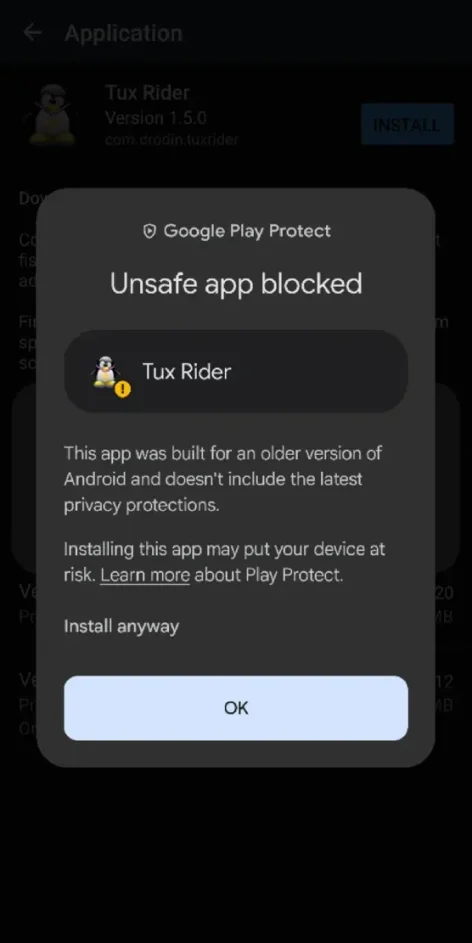
Step 4: Handling Google Play Protect “Unsafe App Blocked” Prompts
When installing power-user utilities like ReVanced Manager APK, Winlator APK, or NetherSX2 APK, Google Play Protect may intercept the installation. It typically displays a warning: “Unsafe app blocked” or “App blocked to protect your device.”
This warning frequently appears when an independent open-source developer releases a brand-new version. The developer’s signing key simply has not built reputation in Google’s cloud telemetry database yet.
Do NOT disable Google Play Protect globally. Doing so leaves your device vulnerable to genuine threats. Instead, approve only the specific verified APK:
- When the Play Protect prompt appears during installation, do not tap “OK” or “Got it.”
- Tap More details directly beneath the warning message.
- Tap Install anyway at the bottom of the expanded card and confirm with your device PIN or biometric scan.
How to Verify an APK Is Safe Before You Sideload It
Because sideloading bypasses storefront curation, follow these three verification habits before installing any .apk file:
- Download Strictly from Upstream Sources: Never download APKs from random Google search scraper sites. Download directly from the developer’s official GitHub Releases page, F-Droid, or verified archives like Celso Azevedo (for GCam APK ports) and APKMirror.
- Match Your CPU Architecture (
arm64-v8a): Almost every smartphone built since 2018 runs a 64-bit ARM processor (arm64-v8a). Avoid downloadingarmeabi-v7a(32-bit) orx86_64emulator builds unless using an older tablet. - Scan Suspicious Binaries on VirusTotal: If you are unsure about an APK file, upload it to VirusTotal.com before opening it to cross-check its SHA-256 hash against 70+ security engines and inspect its requested Android manifest permissions.
Troubleshooting Common APK Installation Errors
If you have enabled Install unknown apps and your APK still refuses to install, use these targeted fixes for the exact error message shown on screen:
- “App not installed as app appears to be invalid” (or “There was a problem parsing the package”):
- Cause 1: The download broke mid-transfer, resulting in an incomplete
.apkarchive. Re-download the file. - Cause 2: You downloaded a Split APK bundle (
.apks,.xapk, or.apkm) instead of a standalone.apk. Standard Android package installers cannot extract split bundles directly. Use an open-source split installer like SAI (Split APKs Installer) or APKMirror Installer instead. - Cause 3: The APK targets a newer minimum Android SDK version (
minSdkVersion) than your phone’s current operating system, or was compiled for a different CPU architecture (x86_64vsarm64-v8a).
- Cause 1: The download broke mid-transfer, resulting in an incomplete
- “App not installed as package conflicts with an existing package”:
- Cause: You already have a version of the app installed on your phone (for example, from the Google Play Store or F-Droid), and the APK you are trying to sideload is signed with a different cryptographic developer key.
- Fix: Back up your app data, then completely uninstall the existing version from your phone. After that, install the new APK. If the error persists after uninstalling, check if the app is still installed inside your Samsung Secure Folder or a secondary user profile. In rare cases, residual package data remains and must be removed via
adb shell pm uninstall com.example.app.
- The “Install” button does not respond when tapped:
- Cause: Android’s anti-tapjacking security blocks you from tapping the “Install” button whenever another app is drawing an overlay on top of your screen (such as blue-light screen filters, floating chat bubbles, or screen recorders).
- Fix: Pause any screen dimming/overlay apps or floating bubbles and tap Install again.
- “App from unverified developer not installed” (Android 17+ Verification Block):
- Cause: On Google-certified devices enforcing Android Developer Verification, sideloading an APK from an unregistered author triggers a hard security block with no override button.
- Fix: Unlock sideloading by enabling the one-time 24-hour Advanced Flow cooldown in Developer Options or bypass the delay immediately via USB or wireless debugging. Follow our complete guide to allow apps from unverified developers for exact ADB commands and indefinite override steps.
Frequently Asked Questions (FAQ)
Does enabling “Install unknown apps” void my phone warranty or trip Samsung Knox?
No. Sideloading standard APK files is an official, built-in feature of the Android OS. It does not unlock your bootloader, does not require root access, and will never trip the hardware eFuse on Samsung Knox (0x0), meaning Samsung Wallet, Google Pay, and banking apps continue working normally.
How do I install an APK file when Android 16 or 17 blocks older Android 6.0 apps?
Starting in Android 14 and enforced strictly through Android 17, Android blocks the installation of legacy apps targeting API level 23 (Android 6.0) or lower to prevent malware from bypassing modern runtime permission prompts. If you need to install a trusted vintage game or classic utility on your phone, connect via ADB or wireless Shizuku and run:
adb install --bypass-low-target-sdk-block filename.apkWhat is the safest way to keep sideloaded APKs updated automatically?
Instead of manually checking websites for new APK versions, install Obtainium. You simply paste the official GitHub, GitLab, or Codeberg repository link once, and Obtainium monitors upstream releases, verifies cryptographic signatures, and installs updates in the background.
Final Thoughts
Android’s security model has evolved from a simple global checkbox into a multi-layered permission framework. Even so, sideloading remains as powerful and flexible as ever. Authorize only trusted installers, toggle off OEM hurdles like Samsung Auto Blocker when needed, and learn how to navigate Restricted Settings. By following these steps, you can unlock the full potential of your hardware safely.
Ready to put your sideloading setup to work? Explore our curated guide to The 2026 Open-Source Android App Stack, automate your GitHub app updates with Obtainium APK, download 4K video and lossless audio with Seal APK, or upgrade your phone’s photography with our GCam APK & XML Config Guide.