
Even a flagship Android smartphone with a multi-core processor and 12 GB of RAM eventually starts to feel sluggish. Budget and older 4 GB RAM devices can grind to a halt within months. Whether you are noticing choppy scrolling, delayed keyboard popups, slow camera launches, or apps constantly reloading in the background, Android slowdowns are almost never caused by worn-out processors.
Instead, modern Android lag is driven by five specific engineering bottlenecks: NAND flash storage write amplification when free space drops below 15%, virtual swap memory (RAM Plus) thrashing, heavy OEM background telemetry daemons, bloated app caches, and default 300ms UI transition timers. Worse yet, installing third-party “RAM Booster” or “One-Tap Speed” apps from the Play Store actually degrades performance by killing cached processes and forcing CPU-heavy cold restarts. In this updated 2026 engineering guide, we walk through 9 proven, hardware-tested steps to make any Android phone, from an older Android 8 device to a modern Android 17 flagship, feel noticeably faster in under 10 minutes.
What Actually Slows Down Android Phones in 2026? (Diagnostic Matrix)
Before changing random settings, identify your phone’s exact symptom in the diagnostic table below to jump straight to the highest-impact fix:
| Symptom on Your Phone | Root Technical Cause | Primary Fix in This Guide | Expected Speed Gain |
|---|---|---|---|
| Opening & switching apps feels slow | Default 1.0x (300ms) window transition timers | Step 1: Set Developer Animation Scales to 0.5x | Instant 2x snappier UI feel |
| Micro-stutters on 8GB/12GB phones | Virtual RAM (RAM Plus / Memory Extension) swapping to slow flash storage | Step 2: Disable Virtual RAM Swap | Eliminates hitching during multitasking |
| Severe lag during app updates or installs | UFS / eMMC flash storage over 85% capacity (Write Amplification) | Step 3: Purge hidden caches with SD Maid SE + Shizuku | Restores up to 3x storage I/O speeds |
| Phone runs warm & battery drains idle | Pre-installed OEM bloatware & carrier telemetry wakelocks | Step 4: Rootless Debloating via Shizuku & Canta | Frees 600 MB to 1.5 GB of active RAM |
| Older 2GB to 4GB RAM phone freezes | Heavy social media apps (full Facebook app using 600 MB RAM) | Step 5: Switch to Facebook Lite or FOSS wrappers | Cuts social app RAM usage by 85% |
| Web pages & feeds jitter while scrolling | CPU-heavy JavaScript ad networks & background tracker sockets | Step 6: On-device DNS/Firewall blocking via RethinkDNS | Faster page loads & lower CPU load |
Step 1: Halve UI Transition Times in Developer Options (0.5x Animation Trick)
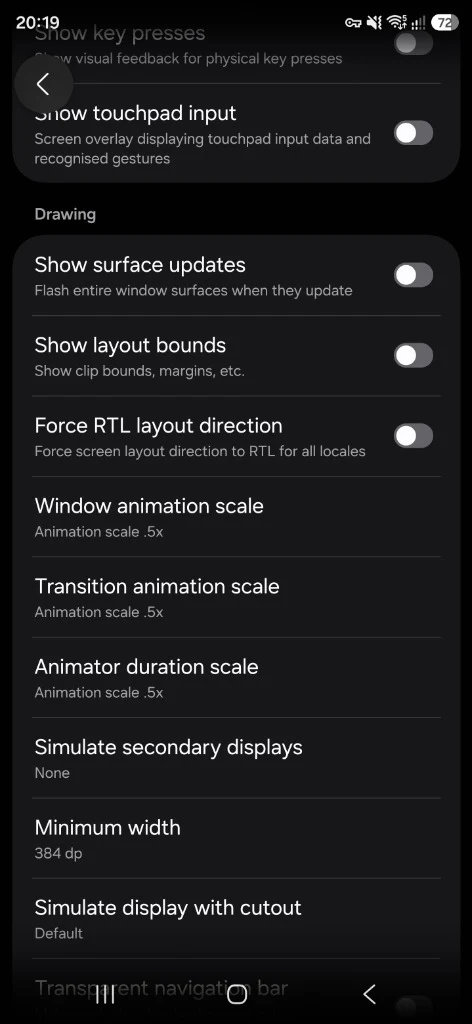
Every time you open an app, swipe home, or pull down the notification shade, Android plays a transition animation set to 1.0x speed (~300 milliseconds). Cutting that multiplier in half to 0.5x (~150 milliseconds) forces the window manager to render transitions twice as fast without losing smooth 120Hz motion:
- Unlock Developer Options: Open Settings → About phone → Software information and tap Build number (or OS version on Xiaomi HyperOS) 7 times rapidly until you see “You are now a developer!”
- Return to the main Settings menu and open Developer options (located at the very bottom of Settings on Samsung One UI, or under Settings → System → Developer options on Pixel/Motorola).
- Scroll down to the Drawing section and locate these three settings:
- Window animation scale
- Transition animation scale
- Animator duration scale
- Tap each of the three options and change them from
1xtoAnimation scale .5x. (Avoid choosing “Animation off”, which can cause visual glitches in certain banking and media apps).
Step 2: Turn Off “RAM Plus” / Virtual RAM Extension on 8GB+ Phones
Almost every modern smartphone manufacturer, including Samsung (RAM Plus), Xiaomi (Memory Extension), OnePlus (RAM Expansion), and Realme, enables “Virtual RAM” out of the box, promising to add 4 GB to 12 GB of extra memory using your internal storage.
Here is the hardware reality: Your phone’s physical LPDDR5X RAM operates at 50,000+ MB/s to 68,000 MB/s. Internal UFS flash storage operates at only 1,500 MB/s to 4,000 MB/s (and eMMC storage on budget phones crawls at 250 MB/s). When Virtual RAM is enabled on a phone that already has 8 GB, 12 GB, or 16 GB of physical RAM, the kernel aggressively pushes active app pages onto slow flash storage, causing noticeable UI micro-stutters and accelerating flash wear.
- On Samsung Galaxy (One UI 6 / 7 / 8 / 9): Go to Settings → Device care → Memory → RAM Plus, toggle it to OFF, and tap Restart.
- On Xiaomi / Redmi / POCO (HyperOS): Go to Settings → Additional settings → Memory extension and select Off.
- On OnePlus / OPPO / Realme: Go to Settings → About device → RAM and toggle RAM Expansion to OFF.
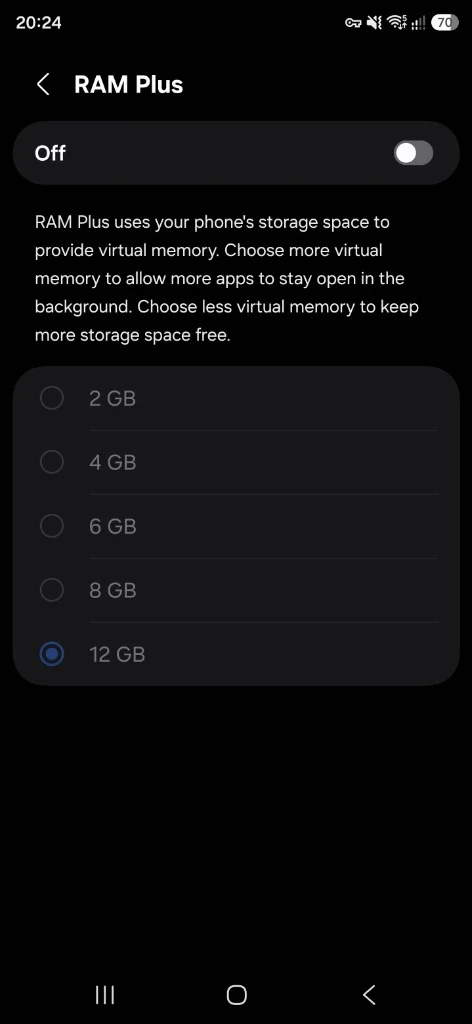
Exception for 2GB to 4GB RAM Phones: If you are using an entry-level phone with only 2 GB or 3 GB of physical RAM, leave a modest 2 GB virtual swap enabled so the OS does not crash when opening a camera or web browser alongside a messaging app.
Step 3: Keep at Least 15% Storage Free & Purge Hidden Caches via SD Maid SE
Solid-state flash memory (UFS and eMMC) relies on empty blocks to perform fast parallel writes and background garbage collection (fstrim). The moment your phone’s internal storage crosses 85% to 90% full, write speeds plummet by up to 70%. This causes severe system freezes whenever apps update or write databases to disk.
Instead of clearing app caches one by one across 150 apps, use our tested workflow in the SD Maid SE & Shizuku Cleaning Guide:
- Install the open-source SD Maid SE FOSS APK alongside Shizuku Wireless Debugging.
- Run CorpseFinder to remove orphaned data folders left behind by old uninstalled games.
- Run AppCleaner to silently wipe 10 GB to 25 GB of bloated browser, social media, and streaming caches in seconds, without losing a single login or saved password.
Step 4: Remove Pre-Installed Bloatware & Telemetry Without Root
Out of the box, commercial Android skins run dozens of persistent background services, such as carrier diagnostics, digital wellbeing trackers, OEM analytics daemons, and hidden Meta background stub services (com.facebook.system and com.facebook.appmanager), that consume 800 MB to 1.5 GB of RAM continuously.
You do not need root access or a PC to strip these out. Follow our complete Rootless Android Debloating Guide using Canta + Shizuku to safely disable non-essential OEM bloatware packages directly on your phone. Every disabled daemon frees up both physical RAM and CPU scheduling cycles for the apps you actually use.
Step 5: Swap Resource-Heavy Apps for Lightweight & FOSS Alternatives
Often, your phone is not slow. Instead, one or two poorly optimized commercial apps are hogging your memory and keeping your CPU cores locked at high frequencies in the background. Making three simple app swaps transforms older and mid-range phones:
- Replace the 1 GB Facebook App: The standard Facebook app consumes up to 650 MB of active RAM and gigabytes of storage cache. Switch to the 3.4 MB Facebook Lite or an ad-free open-source wrapper like SlimSocial from our Facebook & Facebook Lite APK Master Guide.
- Switch to an Ad-Blocking Browser: Modern mobile websites load megabytes of third-party tracking scripts that choke mobile CPUs. Replace standard Chrome with Cromite or IronFox from our 2026 Open-Source Android App Stack to block heavy ad scripts before they render.
- Track Updates Without Play Store Overhead: On older or de-Googled devices where background Play Store updates cause severe UI stutter, manage your open-source apps directly with Obtainium APK.
Step 6: Lock 120Hz Refresh Rate & Restrict Background Battery Hogs
Many phones use aggressive adaptive refresh rate curves that drop your screen from 120Hz down to 60Hz or 30Hz mid-scroll, which your eyes perceive as lag:
- Check Motion Smoothness: Go to Settings → Display → Motion smoothness (or Smooth Display) and ensure High / Adaptive (120Hz) is enabled rather than Standard (60Hz). (Also confirm Power Saving Mode is turned off, as it throttles CPU clock speeds to 70% and caps the screen at 60Hz).
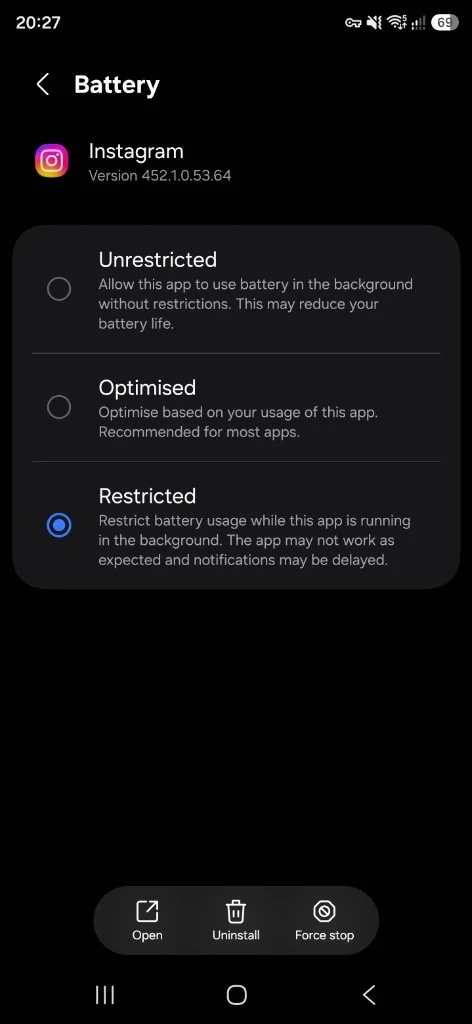
- Quarantine Background Battery Hogs: Open Settings → Battery → Background usage limits (or open Settings → Apps → [App Name] → Battery) and set rarely used shopping, food delivery, and social apps to Restricted (or add them to Deep Sleeping Apps on Samsung). This prevents them from waking up in the background once you swipe them away.
Step 7: Cut Network Wakelocks with an On-Device Firewall
Every time a free game or utility app pings remote advertising and telemetry servers in the background, it wakes up your phone’s cellular/Wi-Fi modem and CPU. By configuring an on-device firewall and DNS blocker using our RethinkDNS & WireGuard Setup Guide, you can completely block internet access for offline apps and enable “Block when device is locked”. This eliminates background network chatter and keeps your phone cool and responsive.
Step 8: Force ART Compiler App Optimization via ADB / Shizuku
After major Android OS updates or months of heavy usage, compiled application profiles inside the Android Runtime (ART) can become fragmented. You can force Android to re-compile and optimize all installed apps for maximum launch speed using a single ADB command (either from a PC or locally on your phone using a terminal connected to Shizuku):
adb shell cmd package bg-dexopt-jobWhen you run this command, your phone will spend 3 to 10 minutes optimizing every installed package using its profiling compiler (the exact same optimization job Samsung’s Galaxy App Booster module runs behind the scenes). Once the terminal returns Success, app cold-start times drop noticeably.
Step 9: Update Android System WebView & Google Play Store
Nearly 70% of modern Android apps use Android System WebView to render internal menus, login screens, and embedded content. An outdated or corrupted WebView build causes widespread app stuttering across your entire device.
- Open the Play Store, search for Android System WebView, and install any pending update.
- If your store itself is lagging or failing to fetch updates, follow our guide to update the Google Play Store APK and clear corrupted store caches.
Frequently Asked Questions (FAQ)
Do “RAM Booster” or “Task Killer” apps actually speed up Android?
No. They actually make your phone slower and drain more battery. Modern Android (Linux kernel memory management) intentionally keeps recently used apps suspended in idle RAM so they open instantaneously the next time you tap them. “RAM cleaner” apps forcefully kill those suspended processes, forcing your CPU to reload the entire app from flash storage from scratch every time you switch apps.
Does restarting my Android phone once a week actually improve speed?
Yes. Rebooting your phone clears temporary kernel memory leaks, resets hung background binder threads, and triggers idle filesystem maintenance routines. On Samsung One UI and Xiaomi HyperOS, you can automate this under Settings → Device care → Auto optimization → Auto restart so your phone reboots itself once a week while you sleep.
Should I change “Background process limit” in Developer Options?
Only on low-memory devices with 2 GB to 4 GB of RAM. On those older phones, setting Developer options → Background process limit to At most 3 processes prevents background bloat from choking the foreground app. On modern phones with 8 GB to 16 GB of RAM, leave this setting at Standard limit.
Final Thoughts
You do not need a factory reset or a brand-new smartphone to restore snappy, responsive performance. By halving your animation scales to 0.5x, disabling slow Virtual RAM swap on 8GB+ phones, maintaining at least 15% free storage with SD Maid SE, and purging background bloatware with Shizuku and Canta, your Android device will run cooler, last longer on a charge, and respond instantly to every tap.